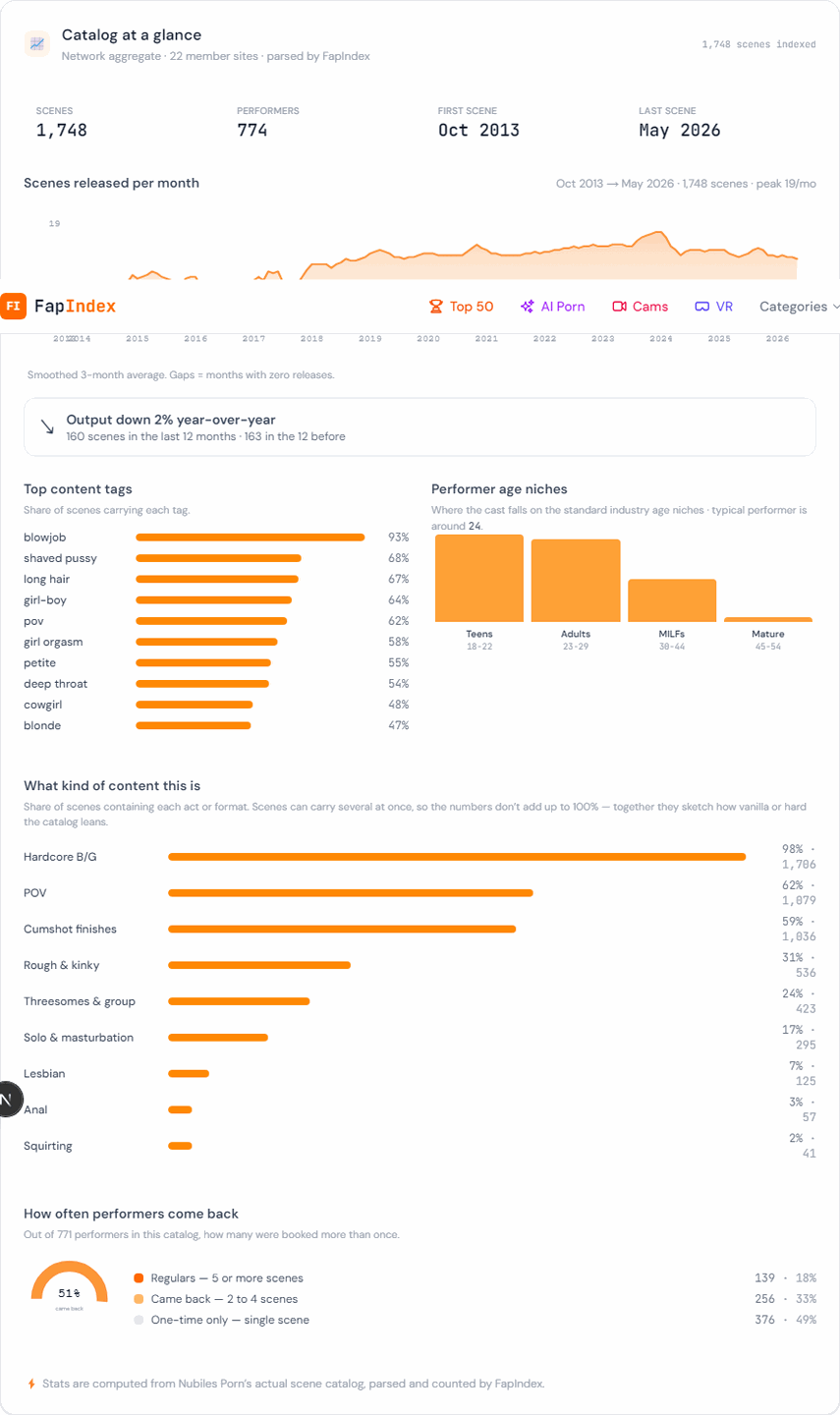
Every FapIndex review now has a new section called Catalog at a glance, sitting between Pros & Cons and Pricing Plans. It answers questions the score and prose can’t answer at a glance: is this catalog still alive, who works here, what do they actually shoot. Seven small charts, no scrolling, no clicks.
Why we added it
Review hero already shows total scenes, last scene date, and a verified date plaque. That tells you whether the catalog is large or small, recent or stale. It doesn’t tell you whether updates are weekly or quarterly, whether the cast is two recurring leads or a hundred one-offs, whether the catalog is anal-heavy or solo-heavy, or whether the median performer is 22 or 38. Readers were asking those questions in their heads and scrolling through the full review prose to piece together an answer. Now they don’t have to.
What’s in the block
Seven widgets, all built from real scene data we’ve indexed:
- Four stat cards. Scenes, performers, first scene date, last scene date. The same plaque you see in the hero, broken out so the rest of the block has shared context.
- 24-month release cadence. A bar per month. Empty months show as empty bars, not gaps, so a quiet stretch looks like a quiet stretch.
- Year-over-year trend strip. Last 12 months versus the prior 12. Colour codes the direction: green if output is growing, neutral if it’s flat, amber if it’s dropping.
- Top tags by scene share. Ten horizontal bars showing what percentage of scenes carry each tag. If 93% of scenes are tagged blowjob and 78% are tagged anal, you know what the catalog is.
- Performer age distribution + median. Buckets are industry niches, not decades: Teens (18-22), Adults (23-29), MILFs (30-44), Mature (45-54), Granny (55+). Age is computed from each performer’s most recent scene on the catalog.
- Content classes. Eleven categories rolled up from scene tags: B/G hardcore, anal, lesbian, threesomes & group, solo, POV, rough & kinky, cumshot finishes, squirting, BDSM & fetish, interracial. Only classes that actually appear render.
- Cast recurrence donut. Veterans (5+ scenes), returning (2 to 4), one-offs. A studio with 60% veterans is a different proposition from one with 70% one-offs.
The dormant-site case
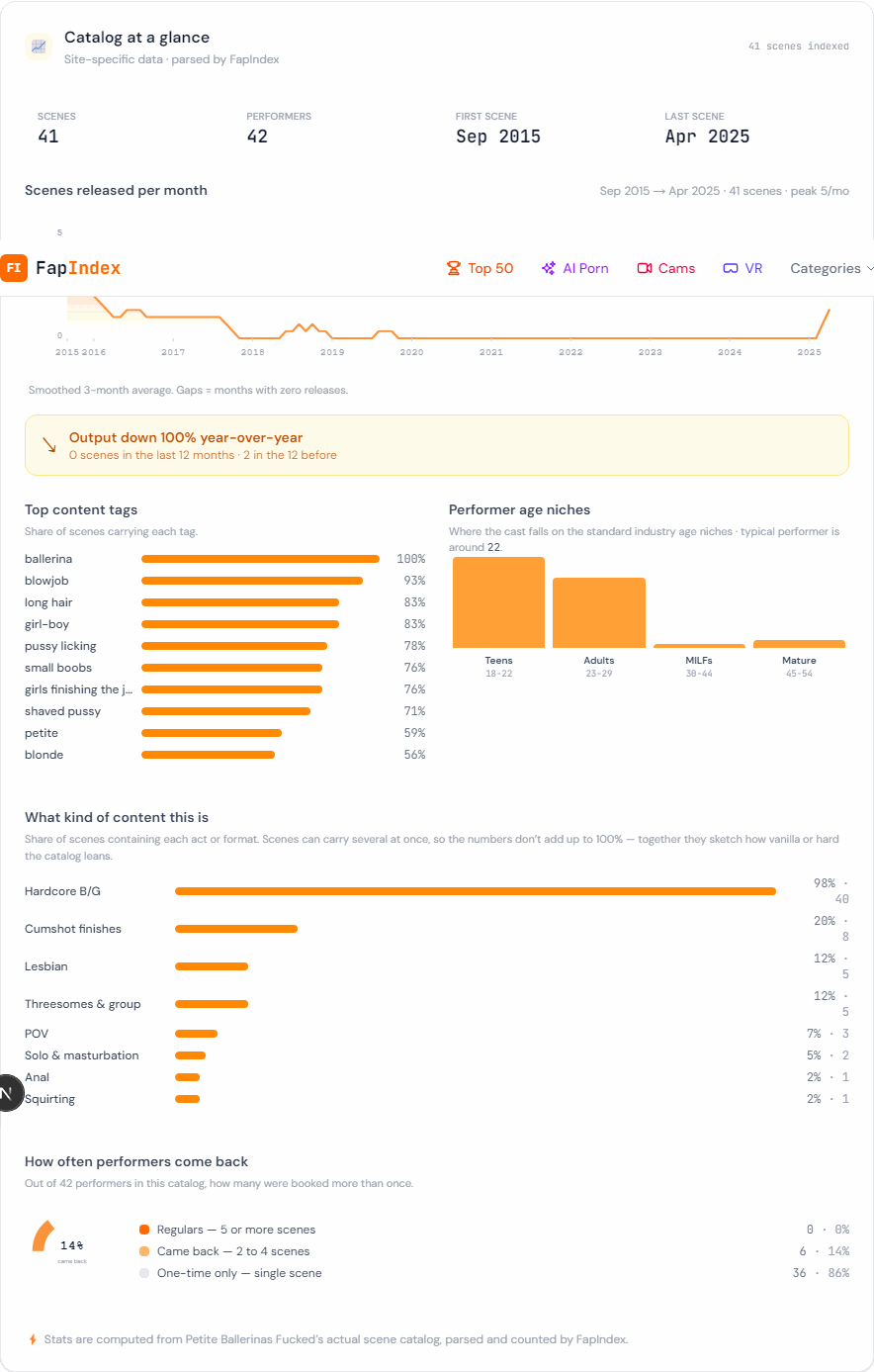
The block earns its keep on sites where the prose looks fine but the catalog isn’t. Take a small studio with 40 scenes and a polished review. The score still computes, the verified date is recent, the verdict text reads positive. But when you draw the cadence chart, 23 of the last 24 months are empty and there’s a single bar in March 2025. The YoY strip reads Output down 100% YoY in amber. The reader gets an honest signal in two seconds that the marketing site has stopped producing, even though the review page is intact.
How the data gets there
Aggregates are pre-computed, not calculated on every page render. When our scene parser runs on a catalog and writes new scenes to the database, a small Python tool rolls up the seven aggregates into a JSON blob and writes it to the review row. The page just reads that blob and draws SVG bars. For network hubs, the aggregation walks all member sites sharing the same network slug and unions everything: scenes, performers, tags, age data. Performers who appear on multiple member sites are counted once, with their most recent last_scene_date and the sum of their scene counts.
If a catalog has no scene data yet, the block doesn’t render. Quiet failure beats a section full of zeroes.
Coverage and what’s next
The block currently renders on roughly 30 to 50 of our 400 review pages, the ones where a scene-parser adapter exists and has run. Coverage expands automatically as the adapter library grows. No template change needed when a new catalog gets parsed, the block just appears.
Two things we deliberately didn’t do this round. No mobile-specific tweaks beyond the default responsive utilities, we want to see how 375px viewports actually handle the SVG bars before optimising. And no comparison annotations on member-of-network pages (something like “this site updates 30% slower than the network average”) because each annotation is another query, and we’d rather ship the block and decide based on real use whether the extra cost is worth it.
Related: the recent scoring update moved a few catalogs around in our top sites. The new block makes it easier to see why a catalog is where it is, not just where it ranks.